A guide to fibers, form, and thoughtful dressing
How to Choose a Luxury Scarf for Layering, Travel, and Everyday Wear
A well-chosen scarf does more than soften the chill. It brings proportion, color, and a note of intention to an outfit, while earning its place through genuine usefulness. The secret is to look beyond appearance: fiber, weight, weave, dimensions, and care all influence how a scarf behaves once it leaves the wardrobe.
The best luxury scarf is not necessarily the thickest, the largest, or the one with the most elaborate pattern. It is the one that suits the way you actually dress. A fine, fluid layer may be ideal for changing temperatures and crowded journeys; a more substantial weave can feel reassuring on a cold walk. Both can be beautiful. Their usefulness depends on how they sit against the body, what they accompany, and how much care you are prepared to give them.
Choosing well begins with a simple question: where will this scarf spend most of its time? Consider commuting, travel, outdoor wear, and the quieter routines of everyday life. Then compare material and construction with the conditions in which you expect to wear it. A scarf that looks compelling on a display table should also feel comfortable at the neck, work with familiar layers, and make sense for the season.
Start with the way you will wear it
A scarf for daily layering has a different brief from one reserved for the coldest days. For regular use, versatility often matters most: a manageable size, a comfortable hand, and a weight that can be looped, draped, or tucked beneath a coat. If the scarf is intended as a travel companion, it should also be easy to fold, carry, and bring out when a cabin, station, or evening breeze turns cool.
Think about the clothing already in your rotation. A scarf worn over a tailored coat may need enough length to create a clean, relaxed line. With a high-necked jacket or bulky knit, a smaller or lighter design may sit more comfortably. For a wardrobe built around quiet neutrals, a scarf can introduce a subtle tonal shift or a considered accent. Pattern and color are not afterthoughts; they determine how readily the piece joins what you own.
It is useful to picture several real outfits rather than an imagined occasion. Would the scarf work with a wool coat, a simple sweater, and a light jacket? Can it move from an outdoor layer to a soft wrap indoors? A design that complements multiple combinations is likely to see more wear than one that depends on a single look.
Understand weight, warmth, and drape
Weight gives an early clue about a scarf’s role, but it is not the whole story. A dense textile can feel warm and protective, while a more open or lightweight construction may offer a softer layer without much bulk. Fiber, yarn, weave, and finishing interact, so two scarves of similar dimensions can behave quite differently. Whenever possible, handle the fabric and notice whether it falls smoothly, springs back, or holds a more structured shape.
Drape is the way fabric hangs and moves. A fluid scarf can form loose folds and sit elegantly under outerwear; a firmer fabric tends to keep its shape and can create a more defined silhouette. Neither quality is inherently better. The right choice depends on whether you prefer a relaxed wrap, a neat knot, or a scarf that stays relatively close to the body.
Warmth also depends on how the scarf is worn. A generous length can be wrapped more than once, creating additional coverage, while a lighter scarf may be most effective when tucked into a coat collar. If you often move between heated interiors and cool streets, a flexible layer can be more comfortable than a very heavy one. For prolonged exposure to cold, prioritize coverage and a construction that feels protective rather than relying on a fine decorative layer alone.
The specification “lightweight” should not be mistaken for “insubstantial.” Fine materials can provide comfort in a compact form, and a scarf’s usefulness may come from its ability to layer without crowding a collar. Conversely, a substantial hand can be welcome when warmth and a cocooning feel are the point. The question is not which weight is most luxurious, but which weight suits your climate and habits.
Choose a fiber with both feel and function in mind
Fiber influences a scarf’s softness, warmth, resilience, and care needs. Cashmere is prized for a soft hand and warmth relative to its lightness, making it a natural choice for refined layering. Wool is valued for warmth and versatility, though its feel can vary considerably with fiber quality, yarn, and finish. Silk is smooth and often lightweight, lending itself to fluid styling and transitional weather, while cotton can offer a breathable, familiar option for less chilly conditions.
These broad descriptions are starting points, not guarantees. A person’s sensitivity to texture, the scarf’s construction, and the way it contacts the skin all matter. If you are sensitive to scratchiness, feel the fabric near the neck rather than judging it by touch on the hand alone. Check whether the label describes a single fiber or a blend, and read the care instructions before deciding that a material will fit your routine.
A pure-fiber label tells you what the textile is made from, but it does not automatically tell you how it will wear. Yarn quality, twist, density, finishing, and craftsmanship can affect the final hand and performance. Clear product information is helpful: look for specific fiber content and construction details rather than relying only on broad terms such as “soft” or “premium.”
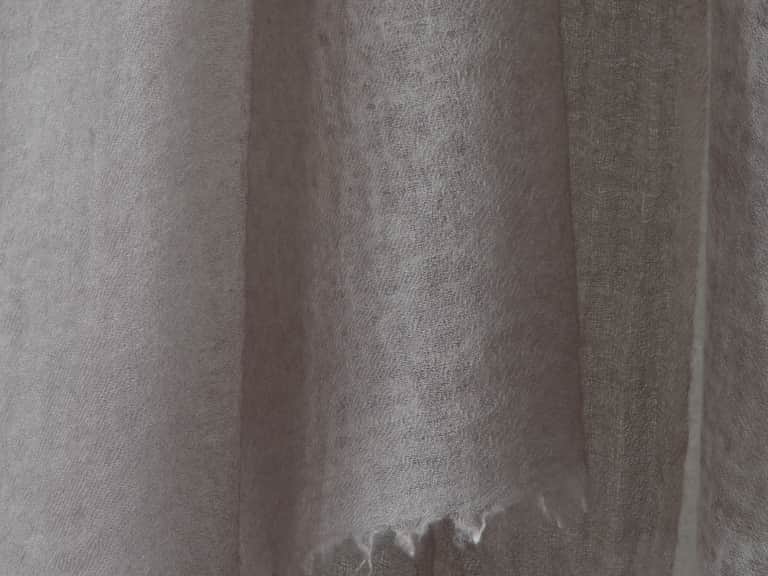
For an example of a cashmere accessory designed with understated layering in mind, consider the Pal Twill Scarf. It is described as pure extra-fine cashmere, with hand-spray dyeing and a garment-dyed finish that creates a distinctive felted effect. Such details offer a useful reminder that material and color treatment together shape a scarf’s character. Before choosing any delicate fiber, consult its specific care guidance and consider whether it fits the way you maintain your clothes.
Look closely at weave and finishing
The weave gives a scarf much of its visual and tactile identity. A plain weave can appear clean and understated; a twill may show a diagonal structure and a supple hand. Open constructions can feel airy and create a lighter impression, while tighter or denser structures may offer more body. The same fiber can look and perform differently when made into different constructions, so fiber content alone cannot answer every question.
Finishing details deserve attention, too. Edges may be hemmed, fringed, or left with a more relaxed finish. A neat edge can contribute to a polished appearance, while fringe adds movement and an informal note. Examine how the finish relates to your wardrobe: a discreet border may feel adaptable, whereas a prominent detail can make the scarf a focal point.
Color treatments and surface effects also influence the mood of an accessory. A solid shade is often easy to coordinate, but even a single color can have depth through dyeing or texture. Subtle irregularities may be part of a deliberate finish; they are not necessarily a flaw. Read the description carefully and, where possible, inspect the scarf in natural light, since indoor lighting can shift how a shade appears.
Get the proportions right
Dimensions affect how many ways a scarf can be worn. A longer style can be looped or left to fall, while a shorter one may sit neatly at the neck with less excess fabric. Width determines whether it reads as a slim accent or can be spread across the shoulders as a wrap. There is no universally ideal size: proportion should be considered in relation to your height, outerwear, and preferred styling.
If you expect to wear a scarf over a substantial coat, enough length to create a comfortable loop may be useful. If you typically wear lighter jackets or dislike bulk around the neck, a narrower or more compact design can feel more natural. A generous scarf offers styling possibilities, but only if you are comfortable managing the extra fabric. Consider how it will fold into a bag or sit beneath a coat when not in use.
Proportion can change the overall impression of an outfit. A long scarf left open creates vertical lines; a closer wrap brings focus toward the face. A broad scarf worn over the shoulders can soften a structured silhouette. These effects are simple, but they make an accessory feel considered rather than merely added at the last moment.
Build a palette that earns its place
For a first or frequently worn luxury scarf, begin with the colors already present in your wardrobe. A shade that echoes a coat, knit, or pair of gloves will be easy to reach for. Consider undertones as well as names: a warm grey, a blue-leaning grey, and a taupe may all be described as neutral, yet each creates a different effect beside the face.
A scarf can also provide a restrained point of color. If your clothes are mostly dark or neutral, a muted green, soft blue, or warm rust may add distinction without competing with the rest of the look. Pattern can be equally versatile when its scale and palette work with your usual clothing. Small, tonal designs tend to blend more quietly; larger contrasts announce themselves more clearly.
Rather than asking whether a scarf is fashionable in the abstract, ask whether its color feels like you and whether it can work across more than one season. A considered palette supports repeat wear. That, ultimately, is part of what makes a luxury accessory valuable: not its ability to command attention once, but its capacity to keep finding a place in daily dressing.
Style it for layering and travel
For an easy everyday look, fold a scarf lengthwise and drape it around the neck, allowing the ends to fall naturally. A simple loop provides more security in wind and can be adjusted as the day warms. Under a coat, keep the arrangement comfortable rather than tightly knotted; the layer should move with you and should not restrict the collar or neckline.
On travel days, versatility is especially useful. Wear the scarf rather than packing it if it is a substantial layer, or fold a lightweight design into a carry-on for changing temperatures. A large, soft scarf can serve as an additional shoulder layer during a cool journey, while a compact one is less cumbersome when you are moving between transport, luggage, and indoor spaces. Avoid placing delicate fabric where it may snag on zippers or rough hardware.
For a more polished silhouette, let the scarf sit cleanly against the neckline of a coat and keep other accessories relatively quiet. With casual clothing, an unstructured drape can feel more relaxed. The point is not to master a long list of knots. A few comfortable ways of wearing the scarf—open, looped, or lightly wrapped—are usually enough to make it useful.
Care is part of the choice
Before purchasing a luxury scarf, read its care label. Some fibers and finishes require professional cleaning or particularly gentle handling; others may be washable under specific conditions. Do not assume that all cashmere, wool, or silk accessories share the same instructions. Following the maker’s guidance is the best way to protect the fabric’s hand, shape, and color.
Between wears, allow a scarf to air before putting it away. Store it clean and dry, folded or laid in a way that does not strain the fibers. Keep it away from rough surfaces that may cause pulls, and take care with jewelry, bag hardware, and coat fastenings. For delicate yarns, avoid repeated friction in the same place, which can contribute to fuzzing or wear.
If a scarf develops a snag or loose thread, resist the instinct to pull it. Pulling can distort the weave. Handle small issues gently and seek appropriate textile repair when needed, particularly if the scarf is valuable or the construction is intricate. Routine, thoughtful care is less dramatic than emergency repair—and generally more effective.
A practical checklist before you decide
- Purpose: Identify whether the scarf is mainly for everyday layering, travel, cold weather, or a combination.
- Fiber: Check the exact composition and consider how the material feels against your skin.
- Weight and drape: Decide whether you want a light, fluid layer or a more substantial wrap.
- Construction: Look at weave, edge finishing, dye treatment, and any surface details.
- Dimensions: Consider how the length and width will work with your coats and preferred ways of wearing it.
- Color: Choose a shade or pattern that complements clothes you already wear.
- Care: Make sure the maintenance instructions are realistic for your routine.
- Repeat wear: Picture the scarf with several outfits and in more than one setting before making your choice.
The luxury of a scarf you actually wear
A scarf is a small textile with an outsized role. It can bring warmth to a familiar coat, soften a crisp silhouette, or make a travel wardrobe more adaptable. The most satisfying choice balances the sensory appeal of a beautiful fiber with practical questions of weight, drape, care, and proportion. When those elements align, the accessory feels less like an occasional flourish and more like a natural part of getting dressed.
Take time to compare materials and construction, and let your everyday habits guide the decision. A scarf does not need to be complicated to feel considered. Choose a fabric you enjoy wearing, a shape that works with your layers, and a color you will reach for often. That is how a luxury accessory becomes not merely an object of admiration, but a dependable companion through changing weather, changing plans, and the small rituals of daily life.